Stamped Concrete Patios & Walkways in Rhodesdale, MD
Start With What Is Underneath
Stamping is a finish. It is a pattern and a color pressed into the top of a slab while the concrete is still soft. That is worth saying first, because it means the pretty part is the last inch. Everything under that inch is what decides whether the patio is still flat and tight in ten years.
That is the honest pitch, and it happens to be Steve's strength. He runs the excavator and the skid steer himself, so the dirt work under the slab is his own work, not a sub he hired and hoped about. A stamped patio built on a soft base looks great in the pictures and bad in three years. A stamped patio built on a packed base looks the same in year three as it did in week one, minus a little color.
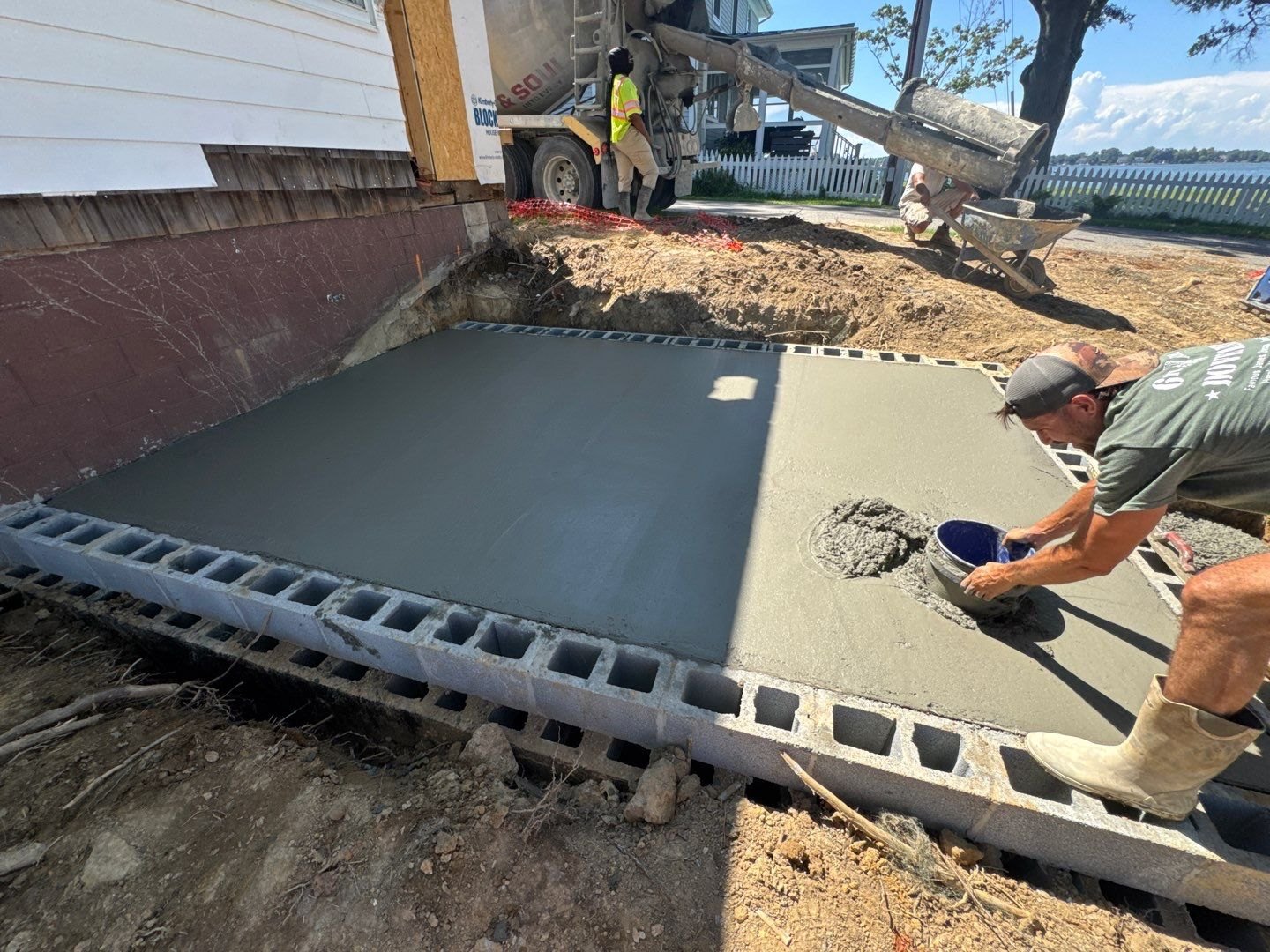
Here is what goes in under a stamped slab. The area gets dug out to depth, and soft or wet dirt gets taken out instead of buried. Stone goes in and gets packed in lifts, so the whole depth is tight and not just the top of it. A real vapor barrier goes over the packed stone. That poly sheet keeps ground moisture out of the bottom of the slab, and on flat Shore ground with a high water table it matters. Wire or fiber goes in the mix so the concrete holds itself together when it does move. Then the slab gets poured to a set thickness and pitched away from the house so water leaves instead of standing along the foundation.
None of that is exciting to read. All of it is the difference between a patio and a mistake.
When You Need This
People come to stamped concrete when they want the look of stone or brick and the simplicity of a slab. It fits a back patio you actually sit on, a walkway from the drive to the front door, an entryway or a landing at a side door, a front porch surface, and a pool deck.
Entryways are the most common single call. That first ten feet of walk gets seen by everybody who comes to the house, and a plain gray strip does the house no favors. A stamped border or a stamped walk changes the whole front of the place for a fraction of what a facelift costs.
Pool decks are the other one. Around a pool you want a hard surface with no gaps and a consistent pitch so water runs off. Stamped concrete does that in one piece.
The other reason people call is that the concrete they have is done. It is cracked, sunk on one end, or the water off the roof has undercut it. If that is where you are, look at concrete removal and replacement first, because the fix is to take it out, correct whatever moved under it, and pour new. The stamping is a decision you make after that.
How Steve Does the Finish
The stamping happens in a window. Concrete goes off on its own clock, and the pattern only presses cleanly while the surface is at the right stiffness. Too soon and the mats sink and smear. Too late and the pattern is shallow and the mats will not seat. That window is the reason stamped work gets planned around the weather and the temperature instead of squeezed in.
Color goes in two ways. A base color goes through or over the whole slab, and then a release agent goes on the surface before the mats come down. The release keeps the mats from sticking and it leaves a second, darker tone sitting in the low spots of the pattern. That contrast is what keeps a stamped slab from looking like one flat color. Once it has cured, the extra release gets washed off and the slab gets sealed.
Steve will talk through pattern and color options with you when he comes out and looks at the job. What he will not do over the phone is promise you one exact pattern or one exact brand before he knows what the space is, what the house looks like, and what is available for the pour.
A stamped slab is still a slab. It still needs control joints, and anybody who tells you different is selling. Joints are cut lines that tell the concrete where to crack, because it will shrink and it will move. What a good installer does is put those joints where they read as part of the pattern instead of fighting it. A joint along a pattern line, at a change of direction, or at the edge of a border disappears. A joint sawn straight through the middle of a stone pattern is the thing you look at forever. Same job, same number of joints, completely different result.
Sealer goes on after the slab has cured. Outdoors it needs redoing every few years. That is normal maintenance, the same way you paint trim. Sealing keeps the color from fading fast, keeps water out of the surface, and makes it easier to clean. Expect the color to soften over time anyway. Sun does that to everything outside. Resealing brings much of it back.
What It Costs in Rhodesdale
Square footage, then the base under it. A patio on firm ground with good access is the cheaper end. A low wet spot needs more dig and more stone, and stone is real money.
After that it is the finish work. How much of the area is pattern and how much is plain. Whether there is a stamped border around a broom finished field, which is a good way to get the look without stamping everything. How many colors. Steps, landings and curves, since edges and steps are slow. Whether old concrete has to come out first. Whether the truck can reach the pour or the concrete has to be moved to the back with the skid steer. Then travel to the site.
Estimates are free. Call 443-439-1019 any time, day or night, and you hear back the same day or the next one.
Common Questions
Does stamped concrete crack?
It is concrete, so it can. Concrete shrinks as it cures and that movement has to go somewhere. That is what control joints are for. Steve packs the base, puts a vapor barrier under the slab, uses fiber in the mix and cuts the joints where they belong, so the movement goes into a joint instead of across the middle.
How is stamped concrete different from pavers?
Stamped concrete is one poured slab with a pattern pressed into the top. Pavers are separate stones set on a sand and stone base. The slab is one surface with joints cut in it. Pavers flex and come apart for repairs. Both work here. It comes down to your ground and what you want it to look like.
Does it need sealing, and how often?
Yes, and resealing every few years is normal maintenance, not a repair. Sealer keeps the color from washing out and keeps water out of the surface. Outdoors the color softens over time no matter what, and resealing brings a lot of it back.
Can you stamp over an existing patio?
Sometimes, but an overlay is a different job than a new pour. It depends on what is under it, whether the slab is cracked or moving, and how thick the existing concrete is. Steve will look at what you have and tell you straight whether an overlay makes sense or whether it should come out and be poured new.
Why Choose Marshy Hope
Steve Hackett owns the business and runs the machine. Fifteen years in the trade, six of them working for himself out of Rhodesdale. He carries a $1,000,000 general liability policy and will send the certificate to you or your builder before he starts. Estimates are free, and you hear back the same day or the next one. One crew handles it from dirt to concrete, so nothing gets dropped in the handoff.
Get a Free Estimate
Call Steve about a stamped patio.
Free estimate, and you'll hear back the same day or the next one.
443-439-1019Open 24/7 · Serving Easton to the Delaware beaches, Salisbury to Centreville
Stamped work is part of the concrete work Steve does in Rhodesdale. Compare it to plain concrete patios and sidewalks and to paver patios and walkways.