Garage & Pole Barn Foundations in Rhodesdale, MD — A Pad That Holds
When You Need This
The building kit is ordered and the builder needs a pad ready. A detached garage is going up beside the house. A pole barn is going in the field for equipment, hay or a shop. A lean-to is being added on the side of a barn that is already there.
The calls that go wrong all sound the same. The pad was dumped fill, smoothed with a box blade and never packed, so the posts settle and the doors stop closing square. The pad was built at the same height as the field, so the floor takes water in every storm. The post holes were dug too shallow, or the footing pads under them were guessed at. The slab got poured later without a thickened edge and the corners broke off under the loader.
Out here the ground works against you. Flat field with nowhere to shed water, a high water table, and soil that runs sandy to clay on the same lot. Both need real compaction — sand because it shifts, clay because it holds water and swells.
How Steve Does It
He walks the spot with you and settles two things first: which way the doors face and how high the floor sits. On flat ground the pad has to be built up so water leaves the building on every side, and the approach still has to work for a truck or a tractor.
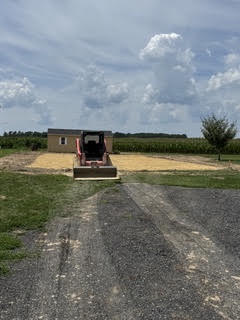
Then he strips the topsoil off the footprint and out past it, because topsoil under a pad keeps settling. He cuts and fills to get the numbers to work, packs the fill in lifts with the plate and the machine as it comes up, and shoots the grade again on top. Stone goes over the packed dirt and gets compacted, run wider than the building so the edges are supported and the drip line does not wash the pad out.
For a post building he lays out the holes off the builder's plan, squared and checked on the diagonals, and augers them to the depth the plan calls for, below frost, with the bottoms cleaned out. He pours the footing pads under the posts where the plan calls for concrete. For a stick-built garage he digs and forms a footer instead, sets rebar continuous on chairs, and sets uprights in the wet concrete on the mason's spacing when there is block above. That top gets screeded dead level for the first course.
If a mason is building block walls, he builds them on the footer Steve set. Steve does not lay block and does not pour foundation walls — that is the mason's trade, and it means the footer is right and ready when the mason arrives.
Then the floor. Stone graded and compacted, poly down where the building is closed in, mesh or rebar on chairs, thickened edges and thickened pads where the posts and heavy wheel loads land, sleeves for electric or air set before the pour. He pours, screeds, floats and finishes, pitching toward the door, tools the edges, and cuts the joints to depth lined up with the openings and posts. Last comes the grade around the outside so water runs away from the walls.
What It Costs in Rhodesdale
The footprint sets the size of everything else. Then it is how much fill the pad needs and how much dirt has to move to get to grade, how deep the stone base has to be to get off soft ground, how many post holes and how deep, whether it is post footings or a formed footer, how much rebar, and slab square footage and thickness. Distance from the road and how far material has to be pushed across the field matters. So does access — a tight lot where the machine cannot swing costs more time than an open field.
Estimates are free. Bring the building plan and Steve will work off it, and he would rather look at the ground than guess over the phone, because how wet that corner of the field gets decides how the pad has to be built.
Why Choose Marshy Hope
Steve Hackett owns the business and runs the machine. Fifteen years in the trade, six of them working for himself out of Rhodesdale. He carries a $1,000,000 general liability policy and will send the certificate to you or your builder before he starts. Estimates are free, and you hear back the same day or the next one. One crew handles it from dirt to concrete, so nothing gets dropped in the handoff.
Get a Free Estimate
Call Steve before the building comes.
Free estimate, and you'll hear back the same day or the next one.
443-439-1019Open 24/7 · Serving Easton to the Delaware beaches, Salisbury to Centreville
This is foundation work for outbuildings. See the rest on the foundation contractor page for Rhodesdale, and read about footers and garage and shop floors.