Garage & Shop Floors in Rhodesdale, MD — A Floor You Can Work On
When You Need This
The pole barn has a dirt floor and everything in it gets dusty or muddy depending on the week. You want to roll a jack across it, set a lift, park a tractor, or run a business out of it, and dirt will not do any of that.
Or the floor is there and it is a problem. It sweats. Water runs in the overhead door every hard rain because the apron outside sits higher than the floor. It is cracked and dusting up, so the surface powders every time you sweep. A corner sank under the tool box. There is no drain and no pitch, so a wash job stays in the middle of the floor.
Shop floors take more abuse than any other flatwork on a property. Point loads from jack stands and posts, a loaded trailer tongue, a skid steer turning in one spot. That is a base and steel question long before it is a concrete question.
How Steve Does It
He starts with the door height and the pitch. A shop floor should sit above the outside grade and fall slightly toward the door so water and wash water leave on their own. He shoots that first, then figures out how much dirt has to come out or go in to get there.
Topsoil comes off, and soft ground gets dug out instead of covered up. Fill goes back in lifts and gets packed as it comes up. Stone base goes over that and gets compacted, and it goes deeper under a shop floor than under a patio because of what will sit on it. On wet ground he ties the stone into a drain so the base can shed water instead of holding it.
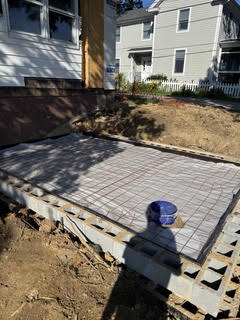
Poly goes down over the packed stone. That is what keeps ground moisture out of the slab, and it is the difference between a floor that sweats and one that stays dry enough to store tools on. Then wire mesh or rebar, set on chairs so the steel ends up inside the concrete. He thickens the slab where a post, a lift or a wheel load lands, and forms a keyed or dowelled edge where the floor meets an existing wall or apron.
On pour day he places, screeds and floats, then waits and works the surface hard. Inside floors get a trowel finish so they clean up and sweep instead of dusting. He can leave a lighter broom on a ramp or right inside a door where you want grip. Edges get tooled and joints get cut to depth in panels sized to the thickness, laid out to line up with the door openings and the posts.
Then it cures under cover if the weather calls for it, and he tells you plainly when you can walk on it, when you can roll on it, and when you can back a loaded trailer onto it.
What It Costs in Rhodesdale
Square footage, then thickness — a floor for cars is not the same pour as a floor for a loader. Mesh or rebar, and how many thickened pads have to go in. How much dirt has to move to hit the door height. How deep the stone base needs to be to get off soft ground. Whether poly, a drain or a sleeve for air or electric goes in first. Whether the mixer can back to the opening or the concrete has to be moved inside by hand. If a bad floor has to come out, that is part of it too.
Estimates are free, and Steve would rather look at the ground than guess over the phone. Tell him what is going to sit on the floor and drive across it, and he will tell you what the base and the steel need to be.
Why Choose Marshy Hope
Steve Hackett owns the business and runs the machine. Fifteen years in the trade, six of them working for himself out of Rhodesdale. He carries a $1,000,000 general liability policy and will send the certificate to you or your builder before he starts. Estimates are free, and you hear back the same day or the next one. One crew handles it from dirt to concrete, so nothing gets dropped in the handoff.
Get a Free Estimate
Call Steve about your floor.
Free estimate, and you'll hear back the same day or the next one.
443-439-1019Open 24/7 · Serving Easton to the Delaware beaches, Salisbury to Centreville
Shop floors are flatwork with a heavier base. See the rest on the concrete contractor page for Rhodesdale, or read about garage and pole barn foundations if the building is not up yet.