Footers in Rhodesdale, MD — Dead Level For The Mason
When You Need This
You have a permit and a print and the mason wants a footer to start on. Or you are adding on — a room, a porch, a garage bay — and the addition needs its own footing tied to the right depth. Or a post has to carry a beam and needs a real pad under it instead of a patio block.
Builders call about footers here for one reason. On dead flat ground with a high water table, a footer that is out of level or dug too shallow costs everybody time. The mason burns block and mortar making up the difference, and every course above it stays off. If it sits in soft ground, it settles and the wall cracks a year later.
Near the Nanticoke, the Choptank and the Marshyhope the hole can take water in a wet stretch, so timing and dewatering matter as much as the digging.
How Steve Does It
He starts at the corners. Layout comes off the print and the stakes, squared with a tape and a laser, then he shoots the whole footprint and sets the bottom elevation from the highest point so the footer stays below frost depth all the way around. Where the print calls for a step, he plans where the steps land so they fall on block courses instead of in the middle of one.
Then he digs with the excavator and cleans the bottom flat. Footers bear on undisturbed ground, not on loose spoil, so anything soft comes out and goes back as stone, not as dirt raked back in. If the ground is wet he digs a sump at a low corner and pumps so he is placing concrete in a clean trench.
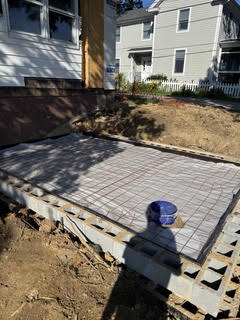
Forms go up where the ground will not hold a straight edge, staked hard and set to the line and the elevation, with keyways where the print calls for one. Rebar goes in continuous, lapped at the splices and bent at the corners, held up on chairs so it is inside the concrete and not lying in the dirt. Where the wall is reinforced he sets the vertical uprights in the wet concrete on the spacing the mason needs, so the steel comes up in the middle of the block cells.
Then he pours, rods it, and screeds the top flat to the grade he shot. The top gets smoothed level, corner to corner, because the mason's first course is only as good as that surface. He checks it again after it sets.
Once the footer has cured, the mason builds the wall on it. Steve does not lay block and does not pour foundation walls — that is the mason's trade, and doing it that way is why the footer is ready and right when the mason shows up. After the wall is up Steve comes back for the rest of the dirt work and the concrete: footer drain and stone, backfill, poly, the sump pit, and the slab.
What It Costs in Rhodesdale
Linear feet of footer first, then the width and depth the print calls for. How many corners and steps. How much rebar and whether uprights get set. How much dirt has to move, and how far the spoil has to be pushed or stockpiled. How deep you are digging, since depth drives both dirt and concrete. Whether the trench needs pumping, and whether the machine can get around the whole footprint or has to work from one side.
Estimates are free. Send the print and Steve will price it, but he would still rather look at the ground than guess over the phone, because water and soft spots are what turn a simple footer into a long day.
Why Choose Marshy Hope
Steve Hackett owns the business and runs the machine. Fifteen years in the trade, six of them working for himself out of Rhodesdale. He carries a $1,000,000 general liability policy and will send the certificate to you or your builder before he starts. Estimates are free, and you hear back the same day or the next one. One crew handles it from dirt to concrete, so nothing gets dropped in the handoff.
Get a Free Estimate
Call Steve before you dig.
Free estimate, and you'll hear back the same day or the next one.
443-439-1019Open 24/7 · Serving Easton to the Delaware beaches, Salisbury to Centreville
Footers are the first step of the foundation. See the whole job on the foundation contractor page for Rhodesdale, and read about new home foundations and footer drains.