
Retaining Walls in Rhodesdale, MD
A Wall Is a Drainage Job Wearing a Stone Coat
Start here, because it is the whole page. Walls almost never fail because the wall was weak. They fail because water built up behind them and pushed.
Dirt is heavy. Wet dirt is much heavier, and it does not just sit there, it presses. Rain soaks into the ground behind a wall and if that water has nowhere to leave, the pressure keeps building until something gives. Then the wall leans out at the top, or bows in the middle, or a section slides. People look at the stones and think they needed bigger stones. They needed a drain.
So the work that matters is behind the wall, where nobody ever sees it. Clean stone backfill, so water moves through instead of soaking into packed dirt. A perforated drain pipe at the bottom of that stone, with an outlet that actually goes somewhere. Filter fabric between the stone and the dirt, so silt does not wash into the stone and plug it up over a few years. Compacted fill in lifts behind the stone zone, so the ground back there does not settle later and drag on the wall.
That is the same trade as a French drain. Pipe, stone, fabric, fall, outlet. If you read that page you already understand most of how a wall gets built.
On the Eastern Shore the outlet is the hard part and the wall is the easy part. The ground is flat, the water table is high, and there is often no low spot within reach to daylight a pipe. That is where the thinking goes on these jobs. Where does the water leave. If the answer is nowhere, the design has to change before a stone gets set.
What Steve Builds
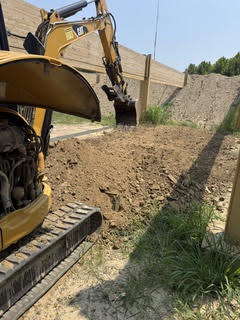
Boulder and stone walls. This is most of the work and it suits this ground. Big stone set by machine, keyed into the bank, each course leaned back into the hill. Boulder walls drain themselves through the gaps between the stones, which on wet flat ground is a real advantage. They also handle a little movement without cracking, because they are separate pieces and not one rigid thing. A 10-ton excavator setting stone is exactly the right tool for it, and that machine is what Steve runs. He is not renting equipment to learn on.
Riprap and shoreline stabilization. Pond banks, ditch banks and shoreline that is washing out. Fabric down, graded stone on top, sized so the water cannot move it, keyed in at the toe so the bank quits losing dirt from the bottom. More detail on the ponds, riprap and shoreline page.
Segmental block retaining walls. Dry-stacked units set on a compacted stone base, course by course, with the setback built into the block and geogrid layers going back into the fill where the height calls for it. No mortar, no masonry. It is a stacked, drained structure and the drainage stone and pipe go in behind it the same as any other wall. This is the tidy option when the wall is part of a finished yard.
Low garden and seating walls. A short wall to hold a bed, edge a patio, square up a slope, or give you something to sit on around a fire pit area. Short walls are simpler, but the base still gets dug and packed, because a garden wall on loose dirt goes crooked in two winters.
Grade changes and terracing. Sometimes the answer is not one tall wall but two short ones with a flat bench between them. Two three-foot walls are easier to build, easier to drain, and stay put better than one six-foot wall. They also give you usable flat ground where you had slope. That is a grading conversation as much as a wall one, and Steve does both, so the two get planned together.
He does not lay masonry block and he does not pour foundation walls. A mason does that work. Stacked stone, boulder, riprap and dry-stacked segmental block are the wall work he does.
How the Job Runs
He walks it first and looks at water before he looks at stone. Where does the water come from, how much land drains toward this spot, where can a pipe come out, and is the ground behind the wall going to stay wet all winter. On a lot of Shore sites the wall lines up with a fix for the wet yard behind it, and it costs almost nothing extra to solve both while the machine is there.
Then he digs the base. A wall gets a trench below finished grade and a packed stone footing to sit on, so the bottom course is buried and locked. A wall set on top of the dirt has nothing holding its toe and it slides out at the bottom.
Then it goes up, course by course, leaned back into the hill, with the drainage stone, the pipe and the fabric going in as he builds instead of being crammed in at the end. Fill gets packed in lifts. The outlet gets set, checked for fall, and daylighted or tied into a line that has somewhere to go. Last comes the cleanup grade so the ground above the wall runs surface water away from the top of it instead of over it.
One more thing, and it is the important one. Anything over about four feet, or any wall holding up a driveway, a building or a structure, generally wants an engineer's design and a permit. When a job is in that territory Steve will tell you so instead of guessing. That is not him backing out of work. It is him not building something that has to come down later.
What It Costs in Rhodesdale
Face footage first, which is length times height, because that is what the wall really is. Then height, since taller walls need deeper bases, more backfill and more stone behind them, and cost climbs faster than height does.
After that it is the site. What the wall is made of and what stone has to be brought in for it. How the water leaves, since a long drain run to a real outlet is added work. What the dirt behind it is doing, because soft wet fill takes more stone and more fabric. Access, and whether the excavator can get to the wall line or has to work at a reach. How much dirt is being cut and moved and whether it can stay on your ground. Whether the job needs an engineer's design and a permit. Then travel to the site.
Estimates are free. Call 443-439-1019 any time, day or night, and you hear back the same day or the next one.
Common Questions
Why do retaining walls fail?
Water. Almost never because the wall itself was weak. Rain soaks the ground behind the wall, the wet fill gets heavy, and it pushes. If there is no clean stone and no drain pipe behind it with an outlet that goes somewhere, the wall leans, bows and comes apart.
Boulder wall or block wall, which is right for my yard?
Boulder walls suit this ground and they drain themselves through the gaps between the stones. They look natural and they handle a little movement. Block walls are straighter and tidier and fit a finished yard, a terrace or a seating wall. Steve sets stone with the excavator, so he will tell you which one the site wants.
How tall can a wall be before it needs engineering?
Anything over about four feet, or any wall holding up a driveway, a building or a structure, generally wants an engineer's design. Steve would rather tell you a job is in that territory than guess at it. Below that, and on a plain grade change, it is straightforward wall work.
Do I need a permit?
Depends on height, on what the wall is holding, and on where it sits. Taller walls and walls near water or a property line usually do. Shoreline and pond bank work has its own review. Steve will tell you what he thinks the job needs so you can check with the county before anybody digs.
Why Choose Marshy Hope
Steve Hackett owns the business and runs the machine. Fifteen years in the trade, six of them working for himself out of Rhodesdale. He carries a $1,000,000 general liability policy and will send the certificate to you or your builder before he starts. Estimates are free, and you hear back the same day or the next one. One crew handles it from dirt to concrete, so nothing gets dropped in the handoff.
Get a Free Estimate
Call Steve about your wall.
Free estimate, and you'll hear back the same day or the next one.
443-439-1019Open 24/7 · Serving Easton to the Delaware beaches, Salisbury to Centreville
Wall work is part of the excavation and site work Steve does in Rhodesdale. See also grading, erosion and sediment control and ponds, riprap and shoreline.