
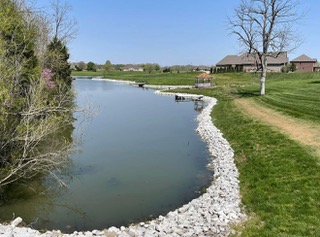
Ponds, Riprap & Shoreline in Rhodesdale, MD — Hold The Bank
When You Need This
The pond bank is falling in. Every year the edge is farther back, the slope is steeper, and there is a cut where the water works at it in a hard blow. Muskrats have honeycombed one side. The overflow washed out and now the pond is dropping.
On the water it is the same fight with a tide behind it. The shoreline is retreating and you are losing lawn. The bulkhead is sound but the ground behind it settled and sinkholes are opening along it. A boat ramp or a pier approach has scoured out. The bank slumped after a storm surge and left a raw face.
This ground fights you. It is dead flat and the water table is high, so the soil is often saturated right where the bank has to hold. Sandy soil moves fast in moving water; clay slumps in slabs when it takes on water. Along the Nanticoke, the Choptank and the Marshyhope the tide goes up and down through the bank twice a day, and floodplain ground gets fully submerged in a big event. A bank built without a real stone section does not last here.
How Steve Does It
He starts by finding out why the bank is failing, because the fix depends on it. Wave and boat wake is one problem. Runoff coming over the top and cutting down the face is another, and no amount of stone at the toe fixes that — the water has to be caught above and carried around. Groundwater seeping out of the bank is a third. Often it is two of the three.
Then permits and lines. Tidal and floodplain work has rules, and he will tell you plainly what has to be approved before a machine touches the bank rather than starting and getting shut down. He works inside the approved limits and puts silt fence and a stabilized entrance in first, because working right at the water is where sediment control actually matters.
Shaping comes before stone. He cuts the bank back to a slope that will stand on its own with the 10-ton excavator, keys a trench in at the toe so the bottom course of stone cannot slide out, and takes out the soft slumped material instead of armoring over it. Voids and muskrat runs get dug out and filled with compacted material.
Then the section gets built in layers. Filter fabric over the shaped soil so the bank cannot wash out through the stone. A bedding layer of smaller stone over the fabric. Then riprap placed with the bucket, sized for the water it has to take — bigger stone where wake and current hit hardest — set and keyed together rather than dumped, thick enough to be a real section, and carried above the high water line so the top does not get flanked. The ends get turned into the bank so water cannot get behind the stone and unzip it.
Behind a bulkhead he digs out the failed ground, backfills in lifts and packs it, and puts stone against the wall where water needs to relieve instead of building pressure. On ponds he shapes the overflow and armors it, sets the outlet so the water level holds, and pitches the ground around the pond so runoff goes to a stable inlet instead of over the raw bank. Last, the top of the bank gets topsoil, seed and straw so roots take hold above the stone.
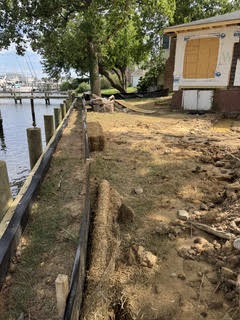
What It Costs in Rhodesdale
Length of bank, then the height of the slope, since that sets how much shaping and how much stone. Stone size and section thickness — bigger water needs bigger rock and more of it. Fabric and bedding stone. How much soft material has to come out and how much compacted fill goes back. Access is a big one on waterfront: if the machine has to reach across a lawn, work off a narrow strip, or wait on the tide, that is time. Permitting and the approved limits of work. Whether an overflow, an outlet or a diversion above the bank is part of it. Then seed, straw and sediment control.
Estimates are free, and this is one Steve will not price over the phone. He needs to stand on the bank and see what the water is doing.
Why Choose Marshy Hope
Steve Hackett owns the business and runs the machine. Fifteen years in the trade, six of them working for himself out of Rhodesdale. He carries a $1,000,000 general liability policy and will send the certificate to you or your builder before he starts. Estimates are free, and you hear back the same day or the next one. One crew handles it from dirt to concrete, so nothing gets dropped in the handoff.
Get a Free Estimate
Call Steve about the bank.
Free estimate, and you'll hear back the same day or the next one.
443-439-1019Open 24/7 · Serving Easton to the Delaware beaches, Salisbury to Centreville
Shoreline and pond work belongs with the water work on the drainage contractor page for Rhodesdale. See also ditching and farm drainage and erosion and sediment control.