Stone & Gravel Driveways in Rhodesdale, MD — Built On A Real Base
When You Need This
You are putting a drive where there is no drive. A new house, a new shop, a new lane back to a barn, or a spot to park equipment out of the mud.
Or the drive you have is done. Not low in one place — done. The stone is gone into the clay, the ruts come back a week after grading, and every spring a delivery truck sinks in the same soft spot. When you are buying stone twice a year and it disappears every time, the base is the problem, not the stone. Grading it again just moves mud around.
Around here a lane also fails at the road. If the ditch water crosses your entrance instead of going under it, no amount of stone stays put.
How Steve Does It
He walks it first and shoots the grade. Where is the high ground, where is the low, where does water come from and where can it go. He looks at the ditch at the road and whether there is a pipe, and whether it is open.
Then he digs. Topsoil and any soft, black, spongy ground comes out with the 10-ton excavator, because you cannot build on it. On flat wet ground he digs deeper and hauls the bad material off to the side of the job. Where the subgrade is soft clay that will pump, he separates it from the stone with fabric. That one step is the difference between a lane that holds and a lane that eats stone.
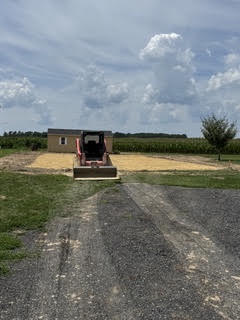
The base goes in coarse — big, angular stone that locks together and bridges soft ground. He spreads and packs it in lifts with the skid steer on tires rather than dumping it all at once, because stone only compacts a few inches at a time. Then the surface course: crusher run where you want it to pack tight and shed water, or a cleaner stone where mud is the bigger worry.
Millings and recycled asphalt are a good option for a long drive with real traffic. They pack down almost like a hard surface, hold in place better than loose stone, and a summer of sun knits them together. He will lay millings the same way — base first, then the millings on top, crowned and packed.
The crown is what most drives never get. He shapes the top higher in the middle so water runs off both sides instead of standing in the wheel tracks. The shoulders get cut so that water has somewhere to leave, and where there is no place for it he puts in a culvert or storm pipe or a shallow ditch line along the lane.
If the plan is asphalt or tar and chip later, he builds the base and the subgrade to take it, then the paving itself gets subbed out to a paving contractor. He does not own a paver and does not pretend to. If you would rather have concrete, that is his own work — see concrete driveways.
What It Costs in Rhodesdale
Length and width first, since both drive the tonnage. How deep he has to dig to reach ground that will hold, and where the bad material goes. Whether fabric is needed over soft clay. How many inches of base and surface stone the use calls for — a car drive is not a lane that takes loaded trucks. Stone or millings, and the trucking to get material to the site. Whether a pipe or a headwall is needed at the road. Access for the machine, and how far he has to move material once it is on the ground. Then finish work on the shoulders, seed and straw where he disturbed grass.
Estimates are free. Steve would rather stand on the lane with you than guess at it over the phone.
Why Choose Marshy Hope
Steve Hackett owns the business and runs the machine. Fifteen years in the trade, six of them working for himself out of Rhodesdale. He carries a $1,000,000 general liability policy and will send the certificate to you or your builder before he starts. Estimates are free, and you hear back the same day or the next one. One crew handles it from dirt to concrete, so nothing gets dropped in the handoff.
Get a Free Estimate
Call Steve about a stone drive.
Free estimate, and you'll hear back the same day or the next one.
443-439-1019Open 24/7 · Serving Easton to the Delaware beaches, Salisbury to Centreville
See the driveway contractor page for Rhodesdale, or read about driveway regrading and farm lanes and field entrances.