
Downspout Drains & Underdrain Systems in Rhodesdale, MD
When You Need This
A roof throws a lot more water than people think. One inch of rain on a normal house roof is well over a thousand gallons, and it all comes out of four or five downspouts. If a downspout dumps two feet from the wall, that is hundreds of gallons soaking the dirt right against your foundation, over and over, every storm, for years.
That is where most foundation trouble on the Shore starts. Not a bad footer. A downspout. The soil beside the wall stays wet, it swells and shrinks, the ground beside the house settles, and then the water finds the block or the slab edge. You see it as a damp crawlspace, a damp garage floor, mulch washed out of the beds, a mud strip along the wall that never dries, or a splash block that has done nothing for ten years.
The other half of the calls are soft spots. A part of the lawn that squishes when you step on it even with no puddle showing. A gravel drive that keeps pumping mud up through the stone. A low corner of the yard that stays wet a week after everybody else's dried. That water is under the ground, not on it, and it needs a pipe that lets water in — which is a different pipe than a downspout line.
Here is the part homeowners get sold wrong all the time, so know it before anybody quotes you. A downspout drain is solid pipe. It carries roof water from the downspout out to an outlet, and nothing is supposed to enter it along the way. An underdrain is perforated pipe in clean stone wrapped in fabric. Its entire job is to let groundwater in and carry it off. They look similar in a trench and they do opposite things. Tie your downspouts into a perforated collector and the roof water blows out of the holes and floods the ground you were trying to dry, which is exactly why so many drains around here quit working after a couple of years.
How Steve Does It
He settles the outlet first. On flat ground with a high water table, the outfall is the hard part of the whole job and everything else follows it. He shoots the yard, the ditch, the lane and the road and finds out whether there is enough fall to daylight the line at a low spot, run it to a ditch or a swale, or tie it into a solid storm line. If there is no fall — and sometimes there is not — then the design changes: a basin with a pump, or regrading the ground so water leaves on the surface instead of in a pipe. He would rather tell you that on the first visit than bury pipe that runs downhill into ground that is already full of water.
For downspout lines he digs with the excavator, keeps the topsoil separate, and cleans the trench bottom to a steady fall the whole way instead of dipping between high spots. Solid pipe goes in, glued or gasketed at the joints, with the fittings running the right direction so nothing catches. Each downspout gets a proper adapter at the top so it is not just a hose stuffed in a hole. Cleanouts go in at the corners and near the ends so the line can be flushed later, because leaves get in eventually no matter what you do.
The end of the line matters as much as the pipe. A pop-up emitter sits flush in the lawn, lifts when the water pushes, and closes behind it so mowers, mud and animals stay out. Where the line daylights at a bank or a ditch, the outlet gets a grate and stone or a small headwall so it does not get undercut and fall in. Steve does not run a line to nowhere and call it done.
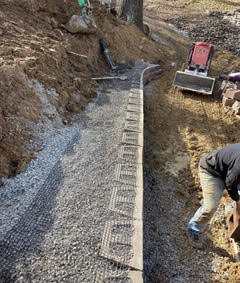
For underdrains it is a different build. Fabric goes down first, wide enough to wrap the whole stone envelope with a good lap at the top. Clean washed stone goes in as bedding — not crusher run, which packs and blinds off and is why old drains are dead. Perforated pipe lays on that bedding with the holes down so water enters low and the pipe can empty itself. More clean stone over it, then the fabric folds over and laps. That wrap is what decides whether it still works in ten years. Under a lawn he brings stone up close to the surface where water needs to enter, then caps it thin with topsoil, seeds and straws.
Under a driveway or a lane the pipe goes deeper, the trench gets packed in lifts, and the surface is rebuilt with stone or concrete to match, so there is no sunken strip across the drive a year from now. Under soft lawn spots the underdrain gets set at the bottom of the wet zone and run to the same outlet. Crossings — walks, drives, patios, existing water and electric lines — get located and worked around, and he keeps roof water and groundwater on separate pipes right up until they meet in a solid line near the outlet.
He works with the skid steer on tires so the yard around the trench is not ruined getting there. Where the real problem turns out to be a wet line across the yard, that is a French drain. Where it is water against the wall of the house, that is footer drains. Where the grade itself is the problem, that is yard drainage and it may be the cheaper day.
What It Costs in Rhodesdale
How many downspouts get tied in, and how far each run has to go to reach the outlet. Trench depth, which goes up under drives and where fall is tight. Pipe size and fittings, and solid versus perforated with stone and fabric, since a stone envelope is the biggest material item on an underdrain.
Then the outlet. A gravity outlet to daylight or a ditch is the cheap version. A basin and a pump costs more and sometimes it is the only thing that works. Soil conditions, since clay digs slower and a trench in a high water table may need pumping while pipe goes in. Crossings under walks, drives and patios. Cleanouts and pop-ups. Access for the machine. Then restoration — packing, topsoil, seed and straw, or stone and concrete where it runs under a drive.
Estimates are free, and Steve would rather stand in the yard during or right after a rain than guess over the phone. Call 443-439-1019 any time, day or night, and you hear back the same day or the next one.
Common Questions
Where does the water actually go?
That gets settled before any digging. Gravity to daylight at a low spot in the yard, into a ditch, into a swale, or into a basin that gets pumped. On flat ground the outfall is the hard part, and if there is nowhere for the line to come out, the design changes.
What is the difference between a downspout drain and a French drain?
A downspout drain is solid pipe. It carries roof water away and nothing is supposed to get in it. A French drain is perforated pipe in stone and fabric, and its whole job is to let groundwater in. Tie a downspout into a French drain and you flood the drain, which is why so many of them quit working.
Will a buried downspout freeze or clog?
It can if it is done wrong. Steve sets solid pipe on a steady fall so it drains itself and holds no standing water, keeps roof water separate from collector lines, and puts a pop-up or a grated outlet on the end. Cleanouts go in so the line can be flushed later.
Can you run it under a driveway?
Yes. Under a drive or a lane the pipe gets set deeper, the trench is packed in lifts, and the top is rebuilt with stone or concrete to match what is there so you do not get a sunken strip across the drive.
Why Choose Marshy Hope
Steve Hackett owns the business and runs the machine. Fifteen years in the trade, six of them working for himself out of Rhodesdale. He carries a $1,000,000 general liability policy and will send the certificate to you or your builder before he starts. Estimates are free, and you hear back the same day or the next one. One crew handles it from dirt to concrete, so nothing gets dropped in the handoff.
Get a Free Estimate
Call Steve about your downspouts.
Free estimate, and you'll hear back the same day or the next one.
443-439-1019Open 24/7 · Serving Easton to the Delaware beaches, Salisbury to Centreville
This is one piece of the water work. See the drainage contractor page for Rhodesdale, and read about French drains, yard drainage and footer drains.